
 Historically, the price of gold shows strong cyclicality, following a 30-year pattern (from one trough to the next). In recent years, the gold bull market has entered a parabolic phase fueled by inflationary pressures and geopolitical events. There is a strong correlation between peaks in gold prices and peaks in U.S. inflation, as gold has consistently functioned as a hedge against inflation.
The Current Secular Gold Market Cycle Beginning in 1999
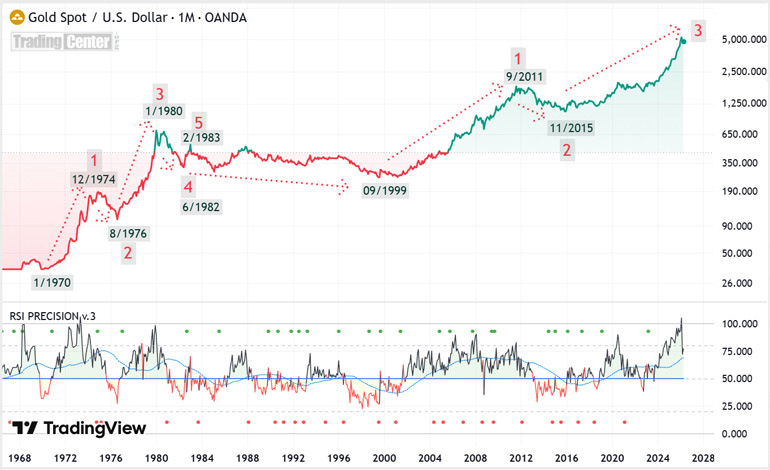
As illustrated in the following chart, from my latest book "The Capital Cycle", the current gold secular cycle began in 1999 and has shown a more prolonged and complex structure compared to the previous cycle, which spanned from 1970 to 1999.
- The first stage of the bull market lasted exactly 12 years (9/1999–9/2011)
- There was a corrective period that lasted nearly 4 years (9/2011–11/2015)
- Currently, gold is in the second stage of the bull market (11/2015–)
The current second stage of the gold bull market cycle is driven by high inflation and resembles the 1970s rally, which was also fueled by hyperinflation. This is where things get interesting, as the two gold market peaks of the 1970s occurred when the U.S. CPI peaked.
Chart: Gold Market Cycles 1968–2026 (based on my book "The Capital Cycle")
The Next Phase of the Gold Market Cycle
If history repeats, the current gold market cycle (trough to trough) should complete by the end of this decade. However, as mentioned before, the current cycle shows a prolonged structure, and that means the duration from trough to trough may be more extended this time. There are specific reasons that could lead to an extended cycle:
- According to the IMF, the global public debt today exceeds $111 trillion, putting more pressure on long-term government bond yields
- High inflation that seems to be stickier than anticipated
- Uncertainty in the global geopolitical landscape (check our previous analysis - Thucydides Trap)
- Central banks are sustaining a record-setting accumulation of gold (they bought 863 tonnes in 2025)
Gold Price Seasonality Throughout the Calendar Year
The gold market exhibits strong seasonality throughout the calendar year, with positive performance in January and a correction in June. Gold is traditionally bullish in the first quarter of the year, and bearish in the second quarter.
- January is the best-performing month (+3.0%)
- July, August, and November are also bullish months for gold
- June is by far the worst-performing month (-0.72%); September is also a negative-performing month
The current rally in gold has carried over into silver, so it’s worth taking a simple, historical look at how silver prices have behaved over time.

Assessment of the Silver Market
As illustrated in the following chart, the price of silver in 2025 started a parabolic bull run. From $30 per ounce in January 2025, the spot price of silver reached an all-time peak of $121.62 per ounce on January 29, 2026. That is an amazing upward movement.
Chart: The Price of Silver 1978–2026
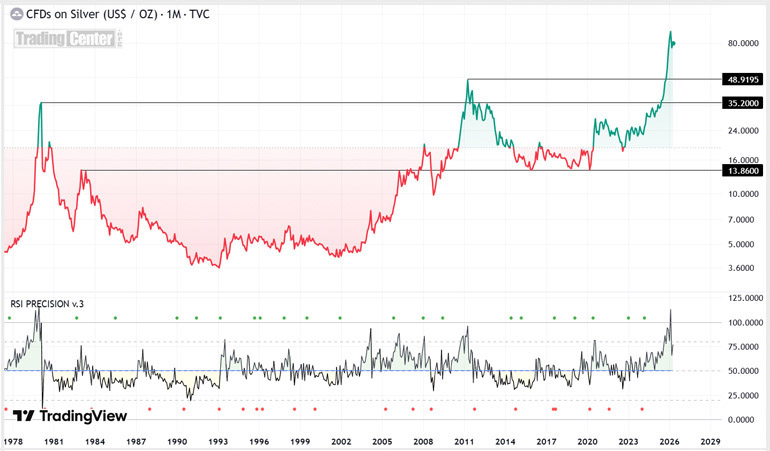
As shown in the chart, silver rallied in the late 1970s, reaching a record high of around $50 per ounce in January 1980. Through the 1980s and 1990s, the price of silver entered a prolonged bear market amid subdued inflation and limited investor interest.
- The start of the 21st century brought dynamism to silver, supported by rising industrial demand and monetary easing. The peak of this bull run occurred in April 2011, when the price of silver approached its all-time high of $50 per ounce.
- Since 2011, silver has entered a bear market that has led its price down to around $14 per ounce in 2015. During the years 2015-2020, the price of silver entered an accumulation period that ended with a distinctive low in March 2020. Since 2020, the price of silver has been in a bull market, which became parabolic after breaking $35 per ounce in mid-2025.
Examining the Gold-to-Silver Ratio
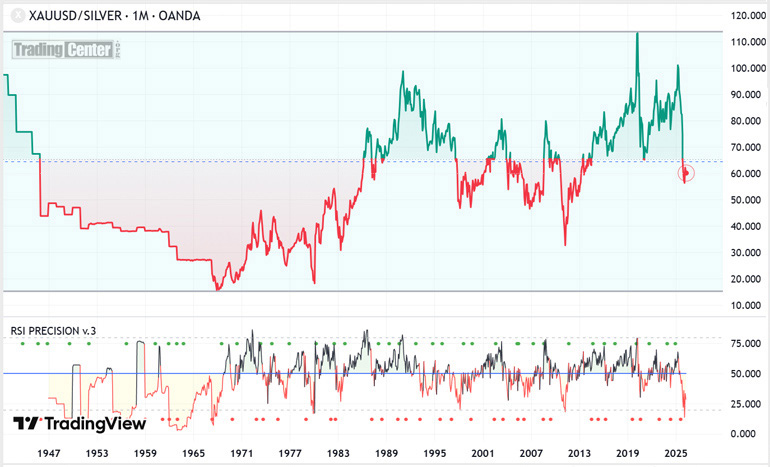
This analysis is completed with the gold-to-silver ratio. Throughout the period 1980-2026, the ratio remains highly dynamic, underscoring silver's greater volatility.
- During periods of financial crisis, such as the 2008 global financial crisis, investors favor gold, and the ratio peaks above 80.
- During risk-on periods or prolonged inflationary environments, silver outperforms gold, and the ratio falls below 45. This happened in 2011, when the ratio fell to around 30.
In recent years, the gold-to-silver ratio has declined sharply, falling from around 100 in May 2025 to 45 in January 2026, and is now back above 60. As shown in the following chart, the gold-to-silver ratio is currently technically oversold. The RSI Precision indicator at the bottom of the chart recently reversed from the 20 level, signaling a strong buying opportunity.
Chart: Gold/Silver Ratio since WW2

Conclusions and Forecast for the Gold Price Over the Coming Years
In an April 2024 analysis, we were bullish on gold, when the price stood at just $2,325/oz. It now exceeds $4,600, having reached a record high of $5,500/oz in January 2026. This represents a substantial move.
If there is no dramatic deterioration in the geopolitical landscape, both the price of gold and silver have already reached their peaks for the current bull market cycle in early 2025. Their charts show the completion of parabolic bull runs in early 2025; the same happened in 1980 and 2011. This resemblance across the three bull markets is further supported by the gold-silver ratio, which formed a notable low in early 2025, mirroring 1980 and 2011.
Regarding the price of gold, I expect a correction period that will last several months (wave-4), and then a final leg up (wave-5). Nobody knows the extent of this final wave-5. Let's consider two different scenarios for the price of gold:
- Scenario-1: The geopolitical environment deteriorates and/or a crisis emerges in the global bond market, with inflation continuing to rise. In this case, the final leg (wave 5) could push prices to a new all-time high beyond $6,500 per ounce.
- Scenario-2: The geopolitical landscape remains relatively stable, and any stress in the global bond market is effectively contained. In this case, the final leg (wave 5) may result in a lower high, below $5,000 per ounce.
Gold is not just an asset -it is an insurance policy against uncertainty
Keep in mind that gold is not just an asset; it serves as an insurance policy against uncertainty. If you own gold, make sure it is physical gold, and ignore price volatility.
■ Gold and Silver Market Cycles and the Gold-to-Silver Ratio
Giorgos Protonotarios, Financial Analyst
TradingCenter.org (c) - April 30th, 2026
Links:
L MORE RESOURCES • COMPARE • GLOBAL MARKETS • FOREX PAIRS • OTHER ASSETS
□ Forex Brokers Comparison
□ Expert Advisors (EAs)
□ Fx Seasonality Calendar
□ TCI Forex Trade Signals
□ Reviews
» Forex Market
» Equity Trading
» Commodities
» EURUSD
» GBPUSD
» USDJPY
» USDCHF
» USDCAD
» AUDUSD
» Historical Perspective on Gold Prices
» Crude Oil Trading
