

The terms “smart money” and “dumb money” describe different types of market participants. Institutional investors and market insiders are called smart money, while small retail traders and short-term speculators are called dumb money. Dumb money often buys and sells at the worst times, so it can be profitable to trade against it.
Understanding Smart and Dumb Money
There are many ways to define smart and dumb money in global financial markets. Generally, smart money refers to investments made by people with deep market knowledge. These may include successful hedge fund managers, wealthy individuals, or insiders with access to privileged information. Dumb money, on the other hand, usually refers to retail investors with limited market knowledge.
☑ Dumb money often follows exhausted trends and uses high leverage.
☑ Retail traders and small speculators are commonly considered dumb money.
☑ According to statistics over a two-decade period, the average retail investor underperformed the market by 2.75% per year.
Overall, the goal of each trader should be to align with Smart Money (hedge funds, institutional investors, market experts, insiders) and take a contrarian approach to Dumb Money (retail traders, leveraged traders, small speculators). The following analysis highlights tools that can help traders track the movements of smart and dumb money.
1️⃣ Monitoring the Weekly COT Report -Applicable Across Forex, Equities, and Crypto
An easy and practical way to track smart and dumb money is through the COT report. The Commitments of Traders (COT) report is a weekly analysis showing the total positions of different players in the US derivatives market. It covers all major asset classes: commodities, Forex, stock indices, and even cryptocurrencies.
Significant changes in the positions of specific participant categories can signal potential trend reversals. The three key categories in the COT report are:
(a) Asset Managers
This includes institutional investors such as mutual funds, pension funds, insurance companies, and portfolio managers serving mainly institutional clients. Large changes in their positions can provide valuable clues.
(b) Dealers
This ‘sell side’ group includes major banks and stockbrokers. Dealers use futures to hedge portfolio risk, making their market behavior complex.
(c) Leveraged Funds (Dumb Money)
This group includes participants using capital leverage for themselves or speculative clients. They are often wrong and represent the ‘dumb money’ in the COT report.
📌 Tip: Trade contrary to Leveraged Funds, especially when Asset Managers and Dealers are positioned in the opposite direction.
🔗 Links:
- More about the COT report on TradingCenter.org
- CME Group -Commitment of Traders
- CFTC.gov -COT Reports Description

2️⃣ Tracking the Smart Money Flow Index (SMFI) When Trading Stocks
The Smart Money Flow Index (SMFI) tracks the market behavior of smart and dumb money. Developed in 1997 by R. Koch (WallStreetCourier), it is based on Don Hays’ Smart Money Index (SMI). In 2003, Bloomberg added the SMFI to their terminals.
Calculations
The SMFI focuses on the Dow Jones Industrial Average and analyzes two key trading periods:
-
Opening: shortly after the Dow opens
-
Closing: during the last hour of trading
While the SMFI formula itself is not public, the Don Hays SMI formula is as follows:
(a) Dow Jones Industrial gain or loss (in points) in the first half-hour (9:30 a.m. – 10:00 a.m. EST)
(b) Dow Jones Industrial gain or loss (in points) during the last hour (3:00 p.m. – 4:00 p.m. EST)
🧮 SMI = yesterday’s Smart Money Index – today’s gain/loss in the first half-hour + today’s gain/loss in the last hour
Utility When Trading Equities (DJIA)
-
Confirming strong market trends
-
Identifying major support and resistance levels
-
Spotting divergences between the SMFI slope and the Dow Jones Industrial's slope, which can signal early trend reversals
Chart: SMI on Dow Jones Industrial (weekly)

📌 Tip: The Smart Money Flow Index can be a useful tool for spotting potential trend reversals in the DJIA. Pay particular attention to slope divergences on higher timeframes.
🔗 Link: » https://www.tradingview.com/script/PQEvcezt-Smart-Money-Index-SMI (SMI on TradingView)
3️⃣ Assessing Dumb Money Confidence When Trading Stocks
'Dumb Money Confidence' tracks several indicators that measure the activity of retail traders and other trend-following participants. While called “dumb money,” a more accurate term might be “trend-following money”, as it reflects participants who follow established trends.
📌 Tip: The ‘Dumb Money Confidence’ is most useful near extreme readings, especially when highly optimistic or pessimistic sentiment begins to reverse.
🔗 Link: » https://sentimentrader.com/dumb-money

4️⃣ Monitoring Market Sentiment: Fear & Greed in Equities and Crypto
The Fear & Greed indicators help gauge the sentiment and expectations of retail investors, who often lose money.
Different indicators exist for different asset classes. It can be useful to trade against retail expectations, as small investors frequently take the wrong positions. However, during a liquidity crisis, avoid trading against retail sentiment.
-
Overbought Area (Greed): A reading near 80 shows excessive greed among retail traders. Smart money may sell in this scenario, aiming to buy back at lower prices.
-
Oversold Area (Fear): A reading near 10 shows strong retail fear. Smart money may buy, aiming to sell later at higher prices.
Example:
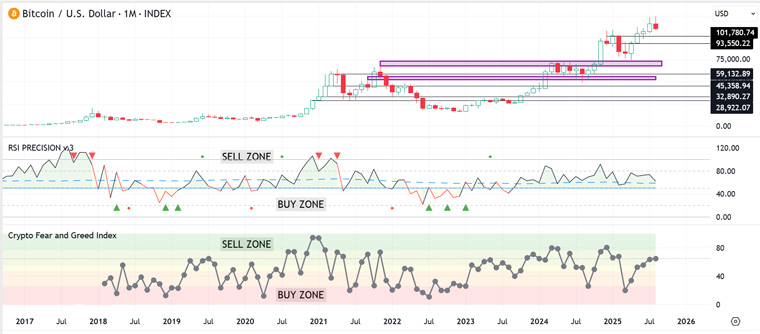
On the monthly chart below (TradingView), the Crypto Fear & Greed Index is shown alongside RSI Precision v.3. The chart highlights the Buy & Sell Zones, demonstrating how these tools can guide market entry and exit points.
Chart: BTCUSD monthly chart along with RSI Precision v.3 and Crypto Fear & Greed index
📌 Tips:
- The indicator is helpful for identifying overbought and oversold conditions, especially near extreme levels.
- Smart money typically trades against extreme readings on the Fear & Greed index.
- However, during rare events like a black swan or liquidity crisis, do not trade against the Fear & Greed Index.
🔗 Links:
- Crypto Fear and Greed Index (Crypto Fear & Greed Index)
- CNN Stocks Fear and Greed Index
■ Dumb Money vs Smart Money (Key Indicators)
G. P. for TradingCenter.org (c)
October 26th, 2023
L MORE LEARNING RESOURCES • COMPARE • TECHNICAL ANALYSIS • LEARNING
□ Forex Brokers Comparison
□ Expert Advisors (EAs)
□ Broker Reviews
□ Learning
• FUNDAMENTAL ANALYSIS
» Financial Ratios
» Money Supply & Liquidity
» Dow Theory & Strategy
» P/E, PEG, and Shiller P/E
» Risk-Adjusted Portfolio Ratios
» Commitments of Traders
» Technical Analysis Guide
» Trading Chart Patterns
» Harmonic Price Patterns
» Forex Technical Analysis
» Fibonacci Primes Sequence
» Naked Charts & Price Zones
» RSI Precision
» PriceMomentum Chart
» TD Sequential
» Key Technical Indicators
» ΔMP and Σ(ΔMP) Indicators
» Wyckoff Method
» Forex Pairs
» Trading Books
» Trading Tips
» Philosophy Section
